How are exactly the workshops designed for students?
Learn languages with spotaneity, creativity and fun!
Dramagloti methodology combines linguistic knowlegde, with pure didactic activities and drama exercices. The workshop has a duration of 2 hours or 3 hours (preferably with no break in between).During the workshop, the teacher is also a participant in the games. The workshops have the following structure:
I. Warm up:
Body warming up: games to awaken the body and have the students ready for improvising and using their bodies in any situation to communicate behind words.
Group cohesion games with different theater exercises based on Viola Spolin methodology + Dramagloti methodology. Cohesion is a very strong tool in theater, and the underlying philosophy is that “I do not function if the other is not functioning.” Here, participants learn to collaborate and be generous with others.
II. Improvisation:
Brainstorm vocabulary of the specific theme agreed upon with the teacher. The brainstorm aims to bring out the vocabulary to be used afterward and also help the students who may not know this vocabulary to participate in the workshops.
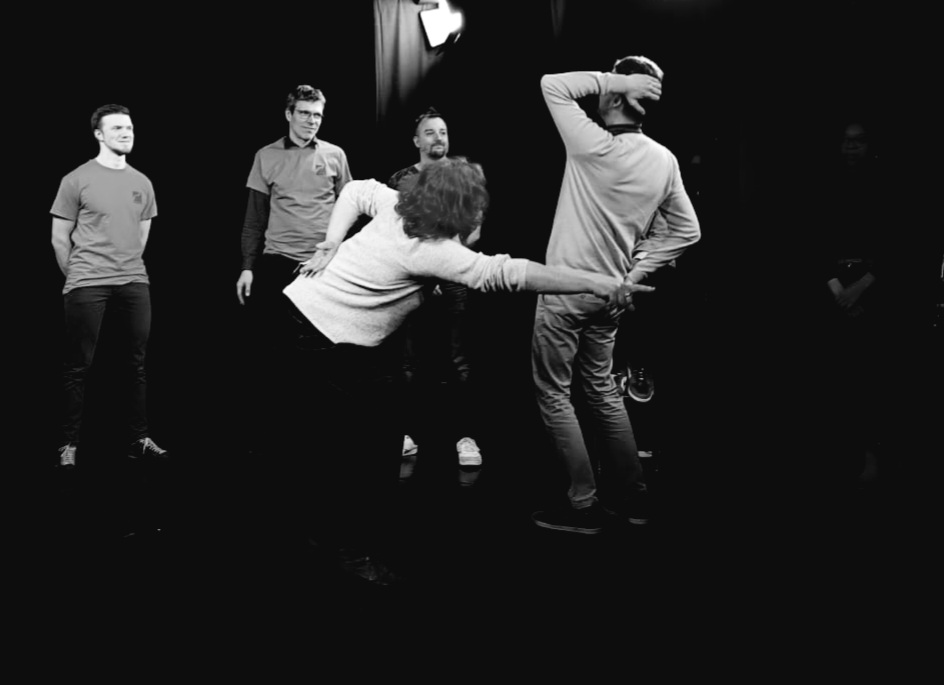
Improvisation games with that vocabulary/ grammar structures: The improvisation part combines physical theater (mimes, gestures) with language. An example of an impro game is “My dream house”, where a first student jumps into the scene by saying “I am a table” and adopts the physical position of a table. A second student follows by adding another element found in the Dream House in relation to the existing one (i.e. “I am a chair next the table”), and more students follow by adding their bodies as elements in the house (i.e. “I am a book under the chair,” “I am a sofa in front of the table and the chair”).
III. Acting in Groups:
Preparation
Students are given diverse lines with which they have to create dialogues and scenes. Although the lines are the same for each group, the scenes are always different as groups decide which lines to use and in which order. Note that with previous groups, some groups have already studied a specific play, so the play was the source of the lines.
Presentation of the play In the presentation of the play, there are two groups: the actors and the audience. Both groups work equally, with one group presenting and interpreting their work while the other observes and gives their full attention to their colleagues.
Workshops designed for teachers’ training
The workshops designes for teachers traning to use theater in language teaching follows a similar structure with breaks in between the exercices to discuss desired outcomes; possible challenges to implement the exercices; possible adapations to the class among other.
Body warming up: games to awaken the body
Group cohesion games with different theater exercises based on Viola Spolin methodology + Dramagloti methodology.
Improvization games: games to awaken the body and have the participants ready for improvising and using their bodies in any situation to communicate behind words.
Preparation of a play with different theater exercises based on Viola Spolin methodology + Dramagloti methodology. Here we discussed the vocabulary target, the grammar and the groups dynamics.
it is important for teachers to walk into students shoes and embodied the experience of acting , playing and creating a play. For each section of the workshops, a diverse rage of possible activities and games is presentent in order to give more ideas and possibilities for exploration according to teachers’ personality but also the needs and academic goals the has for their class.
Outcomes
Theater allows us to connect with ourselves and others. It enhances our curiosity and spontaneity, and we create together with others, engaging in living exercises shaped by each of us. However, it will not function without the participation of others. We turn to solutions and problem-solving by sharing responsibility and trusting the group. Theater is an encounter of ourselves with others, reflecting and mirroring our inner worlds.
Outcomes for students
Experience a different way of learning a foreign language.
Learn by doing.
Collaborate with your classmates and discover new things about them.
Overcome your speaking barriers in a foreign language.
Enhance your creativity and let your imagination guide you.
Discover new potential within yourself.
Gain confidence in speaking a foreign language.
Memorize new vocabulary and expressions.
Play and have fun.
Outcomes for teachers
Motivate students in their learning process.
Teach them useful expressions and vocabulary through play.
Encourage students to interact with each other and possibly discover new friends within the class.
Foster group cohesion.
Address any potential social problems within the group.
Encourage students to explore their potential and creativity.
Make the lessons fun and dynamic.
Teach by example!
Play and have fun!
Invite Dramagloti for a school visit
Dramagloti travels throughout Europe offering workshops to public and private schools, educational institutions, and universities, teaching French, Spanish, Romanian, and English as foreign languages.



 Dramagloti